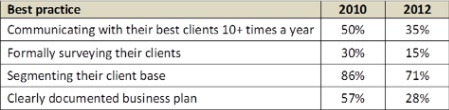




Less than one in five advice businesses regularly survey their clients, according to Business Health, which has also issued a warning about the rise of ‘non-best practices’.
A study of advice practices conducted for Business Health’s Future Ready V report found that just 15% of businesses had a structured approach to seeking client feedback. This was compared with the 2010 results, where one in three businesses had a formal survey methodology.
Given the recent high profile corporate collapses and negative media coverage about the advice industry, Business Health’s Terry Bell said the results almost defied belief.
“The answers we get when we ask advisers why they haven’t surveyed their clients are usually: ‘I already know what they think’, ‘Now’s not a good time’, ‘I’m not ready’, ‘My database isn’t ready’,” said Mr Bell.
… those who do survey their clients make significantly more money
“The reason why that’s frustrating is that those who do survey their clients make significantly more money. Because as soon as you start talking to clients, they start to tell you things. And then if you listen to what they tell you, you might make a change in your business, and improve it.”
According to Business Health’s study, practices that formally ask for feedback are 73% more profitable than those that do not. “Also, by seeking client feedback, and acting upon it, advisers strengthen their relationships with their clients,” Mr Bell said.
“The irony is that when advisers do decide to do survey clients, the response rate is on average nearly 40%. Clients want to provide their feedback. They love to be asked. So there’s actually no downside to doing it.
“Seeking feedback now is an excellent way to gauge your readiness for FoFA,” he added.
The reduction in the rate of businesses conducting regular client surveys is one of a number of ‘best practice’ processes that Mr Bell said had fallen by the wayside in the wake of what he termed a ‘perfect storm’.
“The prolonged effects of the Global Financial Crisis along with the uncertainty and confusion associated with the passage of the Future of Financial Advice (FoFA) reforms, further industry rationalisation and the continued aging of the adviser demographic has created almost the ‘perfect storm’ for the adviser.
“And although most principals (anecdotally at least) continue to acknowledge the importance of addressing the gaps in their operating models, it seems that their time, effort and money have been invested elsewhere over the past few years. And while understandable in one respect, it is difficult to ignore the fact that these gaps do exist and as such, they weaken the practice overall.”