





While the financial advice profession has emerged from years of contraction, a new report from Padua Wealth Data says improving adviser productivity is the industry’s biggest challenge.
Rather than simply rebuilding adviser numbers, the report concludes the profession must improve productivity if it is to meet consumer demand.
The Australian Financial Adviser Market report finds the country’s adviser population has largely stabilised at a widely-reported 15,000 following the post-Royal Commission collapse.
…the pipeline of younger advisers remains too small…
However, the report’s authors caution this should not be mistaken for recovery as adviser numbers sit well below pre-2019 levels. The report argues that the pipeline of younger advisers remains too small to replace the dominant senior cohort as retirements accelerate, it is less than half the size it was in 2018.
Nevertheless, retention among newer entrants is improving, with 94% of the 2025 intake still practising at the beginning of this year.
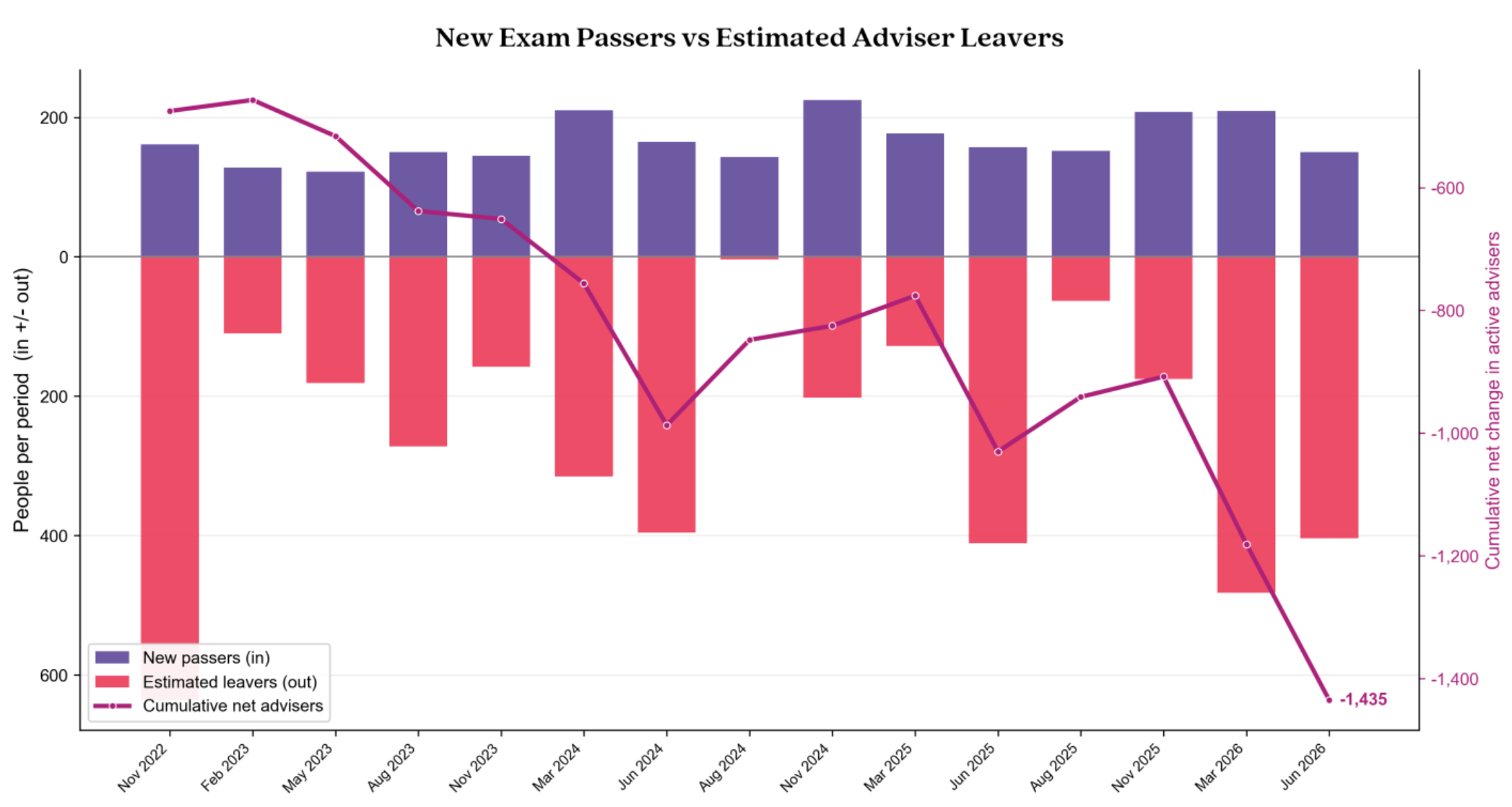
Capacity challenge
Padua estimates around 3.6m Australian individuals and couples currently have a need for financial advice, including approximately 1.8m aged over 60, and states the industry’s capacity problem cannot realistically be solved through recruitment alone.
While AI can perform many routine tasks, potentially freeing advisers to serve more clients, another option already beginning to emerge is AI-generated advice. The report notes that the first licensed AI advice app aimed directly at consumers reached the market in June.

“Where general-purpose tools such as ChatGPT, Claude, and Gemini are not licensed to provide personal advice under the Corporations Act, a licensed platform operates inside the same regulatory perimeter as a traditional practice, carrying a best-interests duty, advice documentation, and supervision by qualified human advisers,” the report states. “Accountable, personalised advice at a fraction of the traditional cost.

The 38-page report concludes the financial advice industry cannot meet consumer demand through adviser numbers alone.
“Even the most accessible supply lever, the reservoir of more than 6,200 exam-qualified people… would lift capacity by at most a few thousand advisers against a need measured in millions,” the report states.
“The emergence of AI-supported advice tools represents a material opportunity to address the capacity ceiling without waiting for the adviser pipeline to rebuild.
“This is not a displacement of the adviser. It is an amplification of adviser capacity in an environment where capacity is the binding constraint.”



When, when, when are the athours of these 'adviser-numbers' articles going to start delineating between risk specialist and an investment adviser? It would give a lot more meaning, granular clarity and relevance to such 'adviser÷numbers' articles. Sure, there' a little overlap but generally riskies and investment advisers are very different animals, completely different skillsets and discipline so reporting on each and both should be done more thoughtfully with more research on the types. One final aspect to be considered in this delineation is that each of these types of adviser has; of necessity, a different culture, training and mindset for entering into and staying in the business. This is of relevance to these articles as it speaks ro some of the reasons the different types may leave the industry. I won't call it a profession as the clownworld of Canberra still runs the whole show, along with the spineless insurance company execs.
Comments are closed.