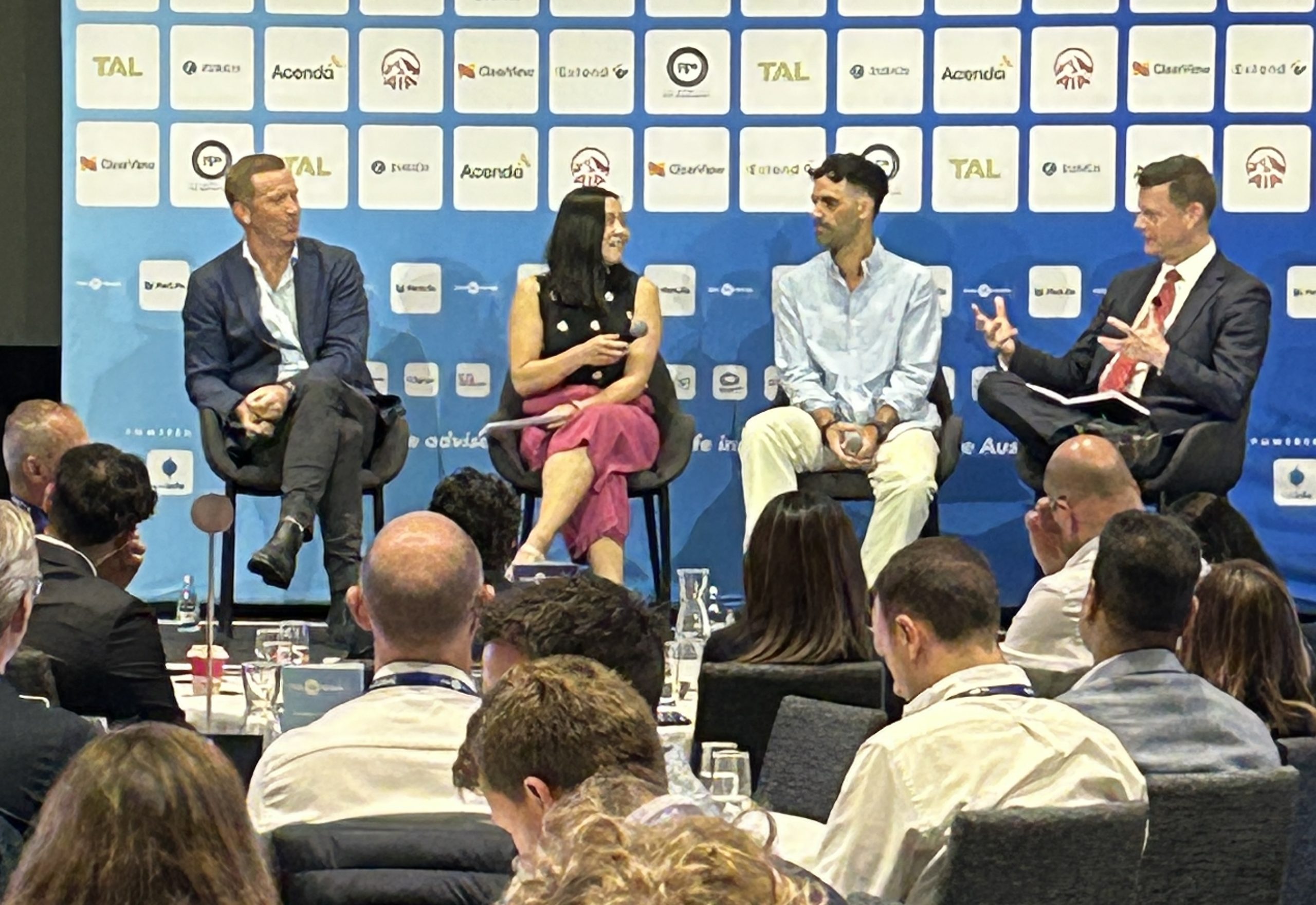

A panel of risk specialists outlined the competing forces reshaping the country’s life insurance advice sector at Riskinfocus 26 in Melbourne. They pointed to rising client affordability pressures, high delivery costs, and the adoption of artificial intelligence.
Moderated by MetLife’s Head of Advice Strategy, Jeffrey Scott, the discussion brought together Jamie McIntyre, Financial Planner and Founder of Mac Financial, Stefan D’Alessandro, Founder of The Risk Lab, and Lautum Life Financial Adviser Nga Vu.
…the panel was unified on what’s driving client conversations
Despite differing business structures, the panel was unified on what’s driving client conversations – cost-of-living pressures.
For Vu, affordability is front and centre, particularly among older clients facing premium increases.

“A large portion of my client base are aged in their 60s and 70s,” she said. “Having those retention conversations is becoming a significant part of my workload. Insurance is competing with a range of other rising costs in clients’ lives.”
D’Alessandro echoed the sentiment, noting cost-of-living pressures are now a feature of almost every client interaction.
“These are the conversations that are hardest, because they’re often outside our control,” he said. “You’re trying to find solutions, but affordability is the limiting factor.”
McIntyre’s concerns were more operational, focusing on compliance and process risk in an increasingly regulated environment.
Cost of advice
One of the central questions posed to the panel was whether the cost of delivering advice had changed over the past 12 months.
Vu reported that costs in her business have increased, largely due to time spent on scoping and investing in technology to improve future efficiency.
“I’m spending more time upfront, trying to build better processes and systems,” she said. “The aim is to reduce costs over time, but we’re not there yet.”
…I’ve pivoted to a model that allows me to serve clients who might otherwise not engage…
By contrast, McIntyre said his firm had begun to see some cost efficiencies, driven by tighter internal processes, selective offshoring, and the use of technology.

His firm operates on a fee-for-service model, with client fees starting at $5,500 and averaging around $8,800 for couples, while internal delivery costs sit between $3,000 and $4,000.
D’Alessandro, operating a commission-based model, said his cost to deliver advice is under $1,000.
“I’ve pivoted to a model that allows me to serve clients who might otherwise not engage,” he said. “Part of that is recognising that clients are coming in more informed than they used to be.
“The dynamic has changed,” he said. “Clients are educating themselves and coming to us to validate their thinking, rather than starting from zero.”
All three panellists pointed to AI as a key enabler of efficiency, particularly in back-office functions, but cautioned the benefits are not automatic.
For McIntyre, the journey began with experimentation using existing tools before moving to specialist platforms.
“Meeting transcription and file note generation have been the biggest wins so far,” he said. “It’s saving time and improving consistency.”
…AI isn’t just about plugging in tools…
Vu described transcription as a “game changer”, significantly reducing the mental load associated with post-meeting admin. But admitted using the technology has involved a steep learning curve.

D’Alessandro, who has a background in computer science, took a more strategic view: “AI isn’t just about plugging in tools,” he said. “You need to rethink your processes to get the full benefit. Otherwise, you’re just layering technology on top of inefficiency.”
He also noted that many gains attributed to AI, particularly in automation, were achievable with pre-existing technologies.
Regulations
The panel and audience agreed that regulatory changes have yet to produce meaningful cost savings.
While reforms were expected to reduce compliance burdens and improve efficiency, the consensus in the room was that these benefits have not materialised in practice.
Instead, advisers continue to navigate complex requirements, with associated time and cost implications.
The discussion also highlighted the ongoing tension between fee-for-service and commission-based models.
While McIntyre advocated for advisers to value their services and charge accordingly, he acknowledged that transitioning to full fee-for-service is not straightforward.
All three panellists agreed the current Life Insurance Framework commission settings (60% upfront, 20% ongoing) are insufficient, with broad support for a review.
See our report: General Advice Gains Traction